Focaccia genovese looks like something a baker threw together between more serious jobs: a flat sheet of dough, dimpled with fingertips, glossy with olive oil, scattered with coarse salt. The first bite tells a different story. Crisp base, a crumb that's soft and faintly chewy, and an oily, savoury top that has you reaching for a second piece before the first is finished. In Genoa it's breakfast, a mid-morning snack, the thing you buy still warm at eight in the morning. At home it takes one long wait, about twenty minutes of real work, a properly hot oven, and more olive oil than feels sensible.
What Sets Focaccia Genovese Apart
It isn't pizza under another name, and it isn't the thin, cheese-stuffed focaccia di Recco either. Focaccia genovese is a yeasted flatbread baked in an oiled metal pan, two to three centimetres thick once baked, with a golden top, a pale open crumb, and a base crisp enough to crack when you bend it. The dough is docked hard with the fingertips, right down to the pan, and then a mixture of water, olive oil and salt — the salamoia — is poured across the surface. It pools in the dents, seeps down through the dough, and effectively fries the bottom as it bakes.
That brine is the step most home versions skip, and it's exactly why bakery focaccia tastes the way it does. Learn that one move and you're most of the way there.
Flour, Water, and Salt: The Numbers That Matter
Use a bread flour with roughly 11 to 12.5 percent protein: an Italian type 0 or 00, or a strong all-purpose. Pastry flour will collapse under the brine, and very strong Manitoba-style flour gives a chewier, more bread-like result than you're after.
Hydration
Classic Ligurian doughs sit around 60 to 65 percent water relative to flour — a firm, cooperative dough, which is what you want when you're making trays by the dozen. At home, start at 70 percent: 500 g flour to 350 g water. The extra water gives a softer crumb and, more practically, a dough that stays open when you dimple it instead of springing back. New to wet doughs? Hold back 30 g of the water and add it only once the flour is fully hydrated.
Salt
This is a salty bread — about 2 percent of the flour weight, so 10 g for a 500 g batch. Don't reduce it. The salt carries the olive oil and stops the finished focaccia tasting flat.
For one 30 x 40 cm pan: 500 g flour, 350 g water, 10 g fine sea salt, and 3 g fresh yeast (about 1 g instant) if the dough will spend the night in the fridge, or 7 g fresh yeast for a same-day rise.
Mixing and Fermenting Without Fuss
- Hydrate first. Stir the flour and most of the water together and leave it for 20 minutes. The flour drinks, the gluten starts forming on its own, and you'll knead far less.
- Add the rest. Crumble in the yeast, scatter the salt, and mix until no dry flour remains. A spoonful of olive oil in the dough is optional; the pan and the top are where the oil really lives.
- Build strength. Knead for eight to ten minutes, or use wet hands to stretch and fold the dough in the bowl every half hour. It should go from shaggy to smooth and slightly tacky; you don't need a perfect windowpane.
- Ferment. Two to three hours at room temperature with two or three folds, or one hour at room temperature then 12 to 18 hours in the fridge. The cold version tastes noticeably better and fits around a working day.
- Warm up. Take the dough out an hour before shaping so it relaxes. Cold dough fights back and tears when you stretch it into the pan.
Olive Oil Does Two Jobs
Be generous and be specific: a good extra virgin olive oil, not a neutral oil. It flavours the bread and it also insulates — it's what lets the base crisp rather than stick. Pour three to four tablespoons into the pan and spread it across the base and a little up the sides before the dough goes anywhere near it. If you're unsure, use more than you think; the excess is poured off or absorbed, never wasted.
Dimpling and the Salt-Water Bath
Tip the dough into the oiled pan and stretch it gently towards the corners. It will resist. Leave it for 20 minutes and stretch again — two or three rounds of this beat one heroic effort. Then let it proof in the pan for 90 minutes to two hours, until it's visibly puffy and jiggles when you shake the pan.
Now dimple. Oil your fingertips and press straight down, all the way to the bottom of the pan, across the whole surface, without tearing. Work quickly and confidently; hesitant poking just makes dents that fill back in.
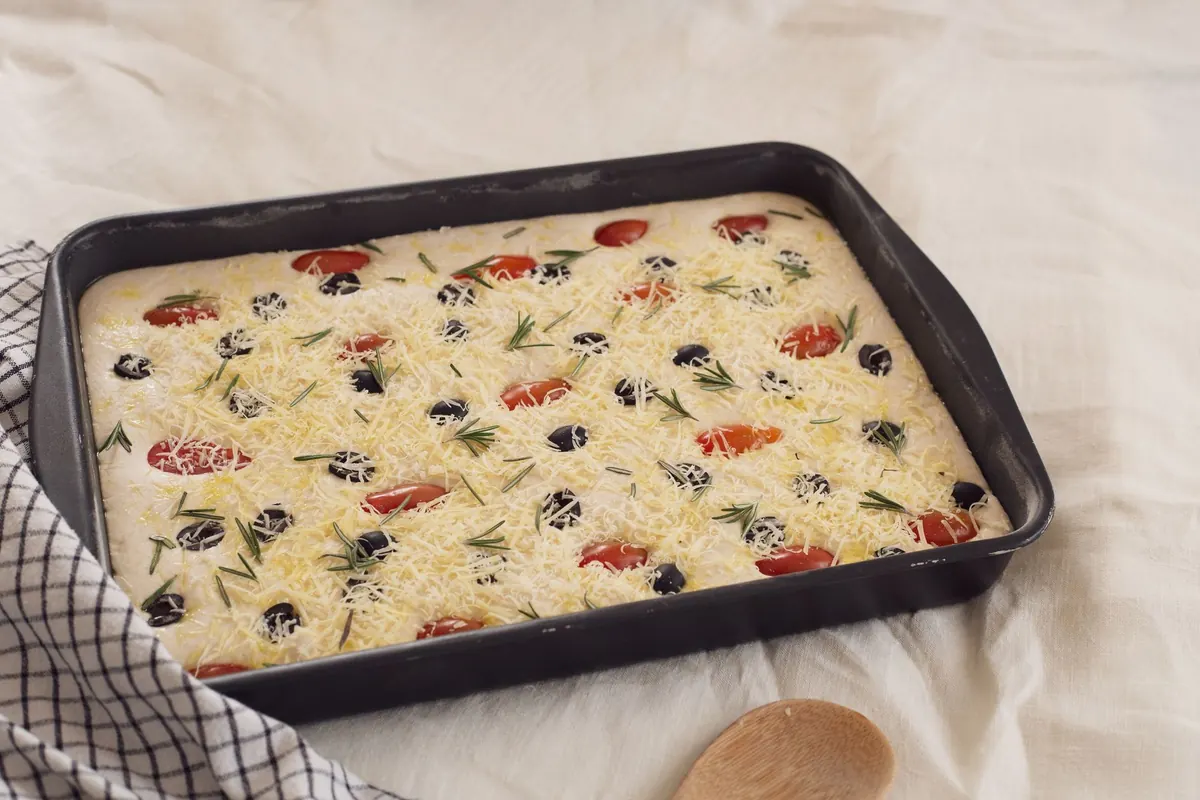
Mix 60 g water, 40 g olive oil and 8 g fine salt, and spoon it over the dough so it collects in the hollows. Wait ten minutes, then dimple once more, gently, so the brine runs into the holes. Scatter coarse salt and, if you like, a few rosemary needles or thin slivers of onion over the top.
Baking Hot, Fast, and From Below
Preheat to 230 °C for at least 30 minutes, static setting rather than fan — a fan dries the surface before the base has had time to colour. Bake on the lowest shelf, or on a preheated stone if you have one, for 18 to 22 minutes. The focaccia is done when the top is deep golden in places and the underside is crisp and evenly browned; lift a corner with a spatula to check rather than trusting the clock. If the top browns before the base is ready, cover loosely with foil and give it another five minutes.
Let it settle in the pan for ten minutes, then slide it onto a board. It's at its best warm, but it's still good four hours later, which is more than most breads can claim.
Your First Bake, and the Ones After
Keep a few notes and adjust from there. If the dough spreads rather than rises, your kitchen is warm or the yeast was heavy-handed — cut it and shorten the proof. If the crumb is tight and bready, add 20 g more water next time. If the base sticks, the pan needed more oil. Cooled leftovers split horizontally make a very good sandwich, and focaccia freezes well in squares, wrapped tightly and warmed in a hot oven for six or seven minutes.
- Weigh everything. Focaccia is forgiving about time and unforgiving about ratios.
- Don't rush the proof in the pan; a puffy dough is the whole point.
- Dimple firmly, twice, with the brine in between.
- Bake hotter and lower than feels comfortable, and check the underside.
Bake it three weekends running and you'll stop measuring the brine and start judging the dough by feel. That's the moment it becomes yours.
Photo: Noemí Jiménez / Pexels